
Published on April 3, 2026
Your Capital is Locked Up – And You Can’t Get It Out
Your venture fund just returned 30% in a single year. Your private equity position has tripled in value. You’re thrilled – until you realize you can’t access any of it for another five years. Your money is trapped, growing faster than any public investment could, but completely inaccessible. You can’t sell it. You can’t redeem it. You can’t use it if a family emergency strikes or a business opportunity arises.
This is the painful reality facing thousands of family offices, wealth managers, and accredited investors who’ve diversified into private alternatives seeking exceptional returns. The returns are real. The wealth is growing. But the freedom to act is nonexistent.
This scenario plays out constantly in the world of private market investing. A venture capital fund delivers exceptional returns. A private equity investment grows faster than anything else in your portfolio. Your alternative investments are crushing it on paper.
But there’s a catch: your money is locked up. You can’t access it when your child needs college tuition. You can’t redeem when a family emergency hits. You can’t pivot your strategy even if market opportunities change. Your wealth is growing but inaccessible, held hostage by lockup periods that feel increasingly outdated in a liquid financial world. And unlike public stocks where you have ultimate control, in private alternatives you’re completely powerless.
This problem exists because most private investments lack what public stock investors take for granted: the ability to sell instantly to someone else. If you own Apple stock and you need $50,000 next month, you can sell shares at the push of a button. Your capital is free within days. But in private alternatives? There is absolutely no one to sell to. There’s no established marketplace. There’s no pricing mechanism. There’s no settlement infrastructure. That’s where secondary market trading comes in – and it’s becoming the most powerful solution for unlocking trapped capital in private investments. It’s the bridge between exceptional returns and actual freedom.
Understanding secondary market trading is no longer optional for sophisticated investors. Whether you’re a family office managing billions, a wealth manager with fiduciary responsibilities for high-net-worth families, or an accredited investor building a diversified portfolio, the ability to execute secondary market transactions directly impacts your ability to manage risk, rebalance your portfolio, respond to changing circumstances, and access capital when life demands it. In a world where alternative investments represent 20-30% of ultra-high-net-worth portfolios, the absence of secondary market optionality is no longer a minor inconvenience – it’s a fundamental constraint on wealth management that can no longer be ignored.
Why Almost All Your Public Investments Are Secondary – And Why This Matters
Here’s a perspective shift that many investors miss: almost every stock or bond you’ve ever owned was purchased on a secondary market. When you buy 100 shares of Apple on the New York Stock Exchange, Apple doesn’t receive your money and doesn’t issue new stock. Instead, another investor – someone who owns those shares currently – sells them to you. You’re participating in the secondary equity market, where existing securities change hands between investors rather than being sold directly by the issuer. This is secondary market trading in its most liquid, efficient form. This happens trillions of times daily across global markets.
For most public companies, the primary market – where the company issues stock directly – happens only once during the IPO and occasionally during secondary offerings. Every other transaction is secondary market transactions between investors. The New York Stock Exchange, NASDAQ, and every other stock exchange on Earth is primarily a secondary market where existing securities change hands continuously.
This is why the secondary market is the lifeblood of modern investing. It gives investors confidence to buy in the first place – knowing they can sell later if life happens. Without functioning secondary markets, the entire stock market collapses because nobody would invest.
The secondary market definition is straightforward but powerful: a marketplace where investors buy and sell existing financial assets with each other, not with the original issuer. The secondary stock market, the secondary capital market, the secondary shares market, and the secondary equity market are all different names for the same fundamental concept. When people reference different terminology, they’re all describing investor-to-investor trading where neither the original issuer nor current holders have special status.
How Secondary Market Trading Actually Works: The Mechanics That Enable Liquidity
Understanding how secondary market trading operates reveals why it’s so powerful. The process is elegant but requires sophisticated infrastructure. A seller decides they need capital and offers their shares or securities for sale. This offer is communicated to the market through brokers, exchanges, or dealers depending on the asset type. Simultaneously, potential buyers express interest by placing bids – offers to purchase at specific prices. The interaction between sell offers and buy bids creates market activity and price discovery. When you see a stock price, that’s the result of millions of these interactions.
When a buyer and seller agree on a price, that’s when secondary market transactions become real. But the process doesn’t stop there. Clearinghouses – specialized financial institutions – verify that both parties have sufficient assets and capital to complete the trade. Custodians hold securities securely and transfer ownership in their records. This infrastructure, though invisible to most investors, ensures that secondary market transactions complete reliably and settle promptly. Modern settlement systems have reduced settlement time from weeks to just a few days, enabling the rapid turnover that characterizes liquid markets.
The role of intermediaries shapes how secondary market trading operates. Exchanges provide centralized venues where buyers and sellers meet. Brokers act as agents, connecting clients with counterparties and executing orders. Dealers make markets by standing ready to buy and sell, profiting from the bid-ask spread. Clearinghouses manage settlement risk. Custodians safeguard assets. Each intermediary plays a specialized role in making secondary market trading efficient and secure. This division of labor is what makes markets work at scale.
The Crisis: Why Private Investments Have NO Secondary Market
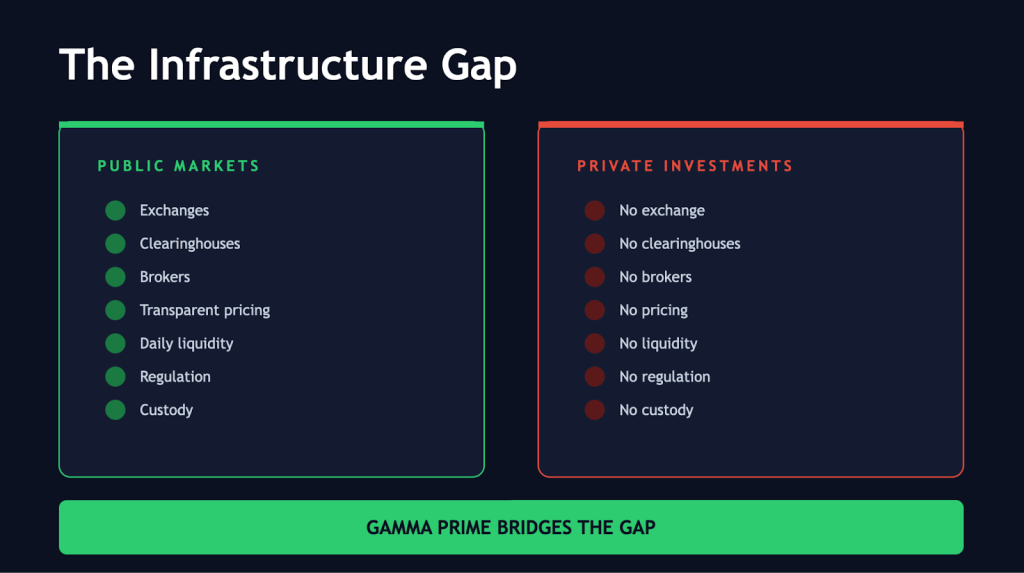
Now comes the uncomfortable truth: while the public secondary stock market is incredibly efficient, transparent, and liquid, the private alternatives world has virtually no secondary market at all. Try to sell your venture capital stake. Try to exit a private equity fund position early. Try to find another investor willing to purchase your hedge fund shares. The secondary shares market for these instruments is essentially nonexistent. This isn’t accidental or temporary – it’s structural.
Why? First, the buyer pool is microscopic. Public stock markets have millions of daily participants. Private venture stakes? Maybe a few dozen qualified buyers worldwide know about your opportunity and have the capital. Second, there’s virtually no pricing transparency. When you buy Apple stock, the last trade price is public information. In private alternatives, neither party knows if they’re getting a fair price. Is it worth $1 million or $10 million?
Without transparent pricing data, negotiation becomes adversarial and difficult. Third, fund managers actively discourage exits. Their documents lock you in deliberately. Why? Constant capital outflows destabilize fund operations and complicate valuations. Fourth, the entire infrastructure is missing. No central exchanges. No communication channels between potential buyers and sellers. No clearinghouses to manage settlement. No regulatory framework that makes transactions straightforward.
This asymmetry – where public investors enjoy liquid secondary market trading but private investors have none – is the defining challenge for wealthy families managing alternative investments. Your private equity position grows 25% annually while your public portfolio returns 10%, but you can’t access it, can’t rebalance because of it, and can’t manage the risk concentration it creates in your overall portfolio. You’re forced to accept a capital structure that doesn’t match your actual risk tolerance or life circumstances.
Secondary Market Examples: The Free Investor vs The Trapped Investor
Two real-world stories illustrate why secondary market access fundamentally transforms wealth management. Sarah, a wealth manager for a family office, invests $100,000 in Apple stock at $150 per share. Two years later, Apple hits $200. Her position is worth $133,000 – a solid 33% return. But the family’s circumstances change.
A younger generation needs capital for a business venture. Sarah has a decision to make that takes literally seconds. She opens her brokerage. She reviews the current Apple stock price: $200 per share. She clicks ‘Sell 100 shares.’ Within 30 seconds, a matching buyer is found at market price. Her shares are sold. Settlement happens automatically through the clearinghouse. Cash hits the family’s account within two business days. Problem solved. This is a perfect secondary market transaction. She had complete optionality and could respond immediately to changed circumstances.
Now consider James, also a family office manager, who invests $100,000 in a private venture capital fund promising 20% annual returns. After five years, his position has grown to $248,832. Incredible returns – far outpacing public markets and justifying the illiquidity premium.
But the family needs capital for important reasons. A college tuition bill arrives. A real estate investment opportunity appears that could generate even higher returns. James calls the fund manager: ‘Can I redeem some shares?’ The answer is crushing: ‘No. Fund documents require a minimum 10-year hold. You’ll receive your proceeds when the fund liquidates in five more years.’ His wealth has tripled, but it’s completely inaccessible. He can’t respond to changed circumstances. He can’t rebalance his family’s overall portfolio. He can’t deploy capital to better opportunities as they emerge. No secondary market transactions exist to solve his problem. His family is penalized for investing in exceptional returns.
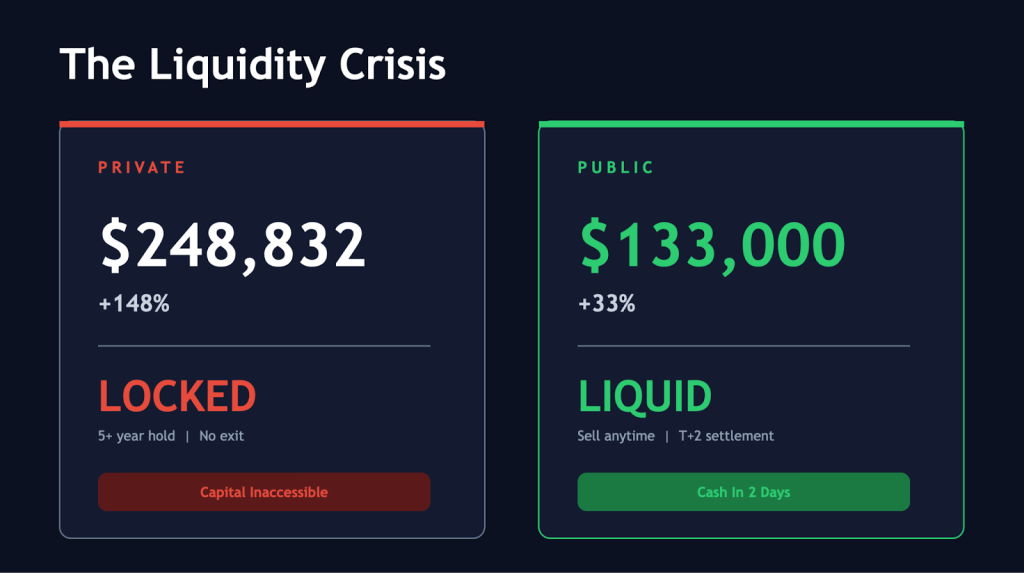
These secondary market examples show why optionality matters. The difference between Sarah and James isn’t the quality of investments – both earned strong returns. The difference is access to secondary markets. Sarah could respond to life. James couldn’t. This distinction matters profoundly when managing significant wealth and navigating the unpredictability of life circumstances.
Types of Secondary Markets: Where They Exist and Where They Don’t
Understanding the landscape of secondary markets helps investors identify where they have optionality and where they’re trapped. Public equity markets function beautifully at scale. The secondary equity market operates with millions of shares trading daily at transparent prices. You can sell in seconds. Wealth managers use these for core holdings because they’re liquid and reliable. Family offices use these for tactical positioning, knowing they can adjust quickly. Individual accredited investors trade these constantly. The entire system works because of enormous scale and complete transparency. This is the gold standard.
Bond and fixed income markets are the second pillar of functioning secondary markets. Here, the secondary capital market for debt works relatively well, though less transparently than equities. Large institutional investors trade billions in bonds daily through dealer networks. A pension fund can sell a bond position to an insurance company. Interest rates fluctuate, bond prices adjust, and trading happens continuously. But you need a serious scale – large positions – to participate effectively. The lack of transparency compared to stocks reflects the nature of the bond market.
Private securities represent the void – the crisis point. Try to sell your stake in a private venture fund. Try to exit a private equity position early. Try to find another investor for your hedge fund shares. The secondary shares market for these instruments is essentially nonexistent. This is the crisis point for modern investors managing alternative investments. Derivatives markets, funds, ETFs – each has different secondary market characteristics. Understanding where secondary markets function and where they collapse is critical to portfolio management.
The Wealth Manager’s Fiduciary Dilemma
Consider a sophisticated wealth manager overseeing a family office with $500 million in assets. This portfolio includes $100 million in private alternatives – venture capital, private equity, hedge funds. For years, these alternatives delivered exceptional returns and the allocations were appropriate. But now economic conditions shift dramatically. Interest rates change. The family’s risk tolerance decreases due to a change in generational leadership. New family members join governance with different perspectives. The wealth manager recognizes they should reduce alternatives from 20% to 12% of the total portfolio. This is prudent stewardship. This is exactly what fiduciary responsibility demands. The math is clear. Diversification and risk management require this rebalancing.
But here’s the impossible situation: those $100 million in private positions can’t be sold. Secondary market trading for private securities doesn’t exist at scale. The wealth manager is forced to remain overexposed to illiquid, concentrated assets regardless of what risk management principles demand. Their fiduciary responsibility requires managing risk across the family portfolio, monitoring concentration, and adjusting allocation as circumstances change. But the infrastructure to do so simply doesn’t exist. Until now, this has been a bitter reality.
Wealth managers have been forced to choose between their fiduciary duties and the reality that secondary markets don’t exist for private investments. Gamma Prime changes this equation entirely.
How Gamma Prime Changes Everything
This is where Gamma Prime alternative investment marketplace enters the story. We’ve built what the market has been missing: an actual, functioning secondary market infrastructure for private investments. Let’s walk through what changes for each type of investor.
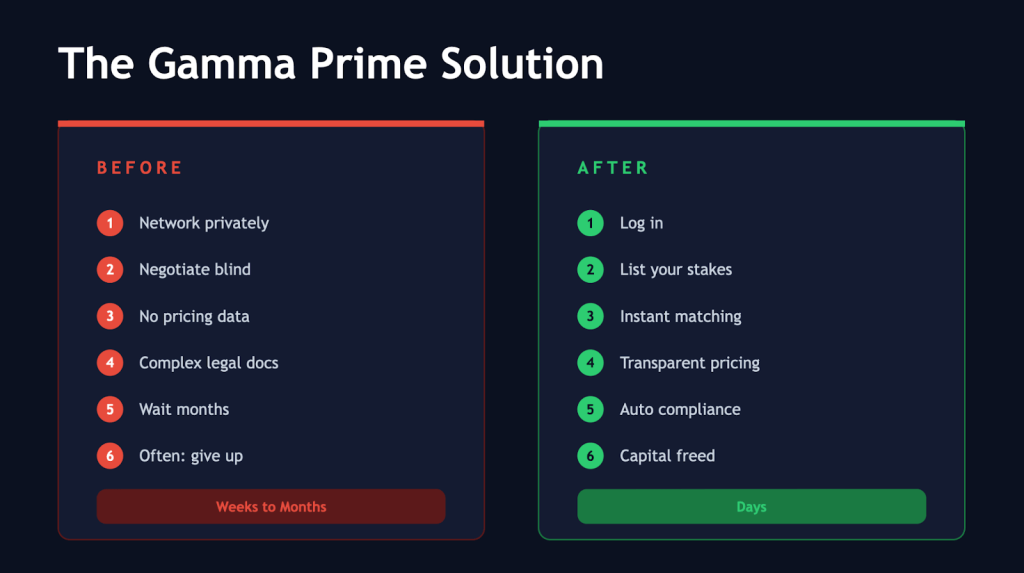
Before Gamma Prime: You want to sell a private stake worth $500,000. You personally network with other wealthy individuals, hoping someone might be interested. You negotiate valuation with zero transparency and no comparable transaction data. You navigate complex legal documentation with tax implications. You deal with fund manager approvals and regulatory compliance. The process takes weeks or months. Most often, you give up and stay locked in. The capital remains inaccessible. Years pass. Circumstances evolve. But your capital is still trapped.
After Gamma Prime: You log into our platform. You list your private stakes. Our matching system connects you with qualified buyers actively seeking exposure to those exact investments. You see transparent pricing based on buyer interest and comparable transactions. You execute the secondary market transaction with Gamma Prime partners handling all legal, compliance, and settlement logistics. Your capital is free. Your secondary market investments work harder for you.
For family offices, this fundamentally changes portfolio management. You can finally execute true rebalancing. You can match your asset allocation to actual risk tolerance instead of being held hostage by illiquid positions. For wealth managers, this means you can finally execute the asset allocation strategy that your clients’ risk profiles demand. You can fulfill your fiduciary responsibilities. For accredited investors, this means your alternative investments provide both exceptional returns AND liquidity optionality.
Why This Matters: The Transformation of Private Investing
Understanding secondary market investments and how to access them is no longer optional for professional investors. The ability to execute secondary market transactions in private positions fundamentally transforms how you manage capital.
It enables liquidity when life happens – when business opportunities arise, when educational costs hit, when family priorities change. It allows price discovery through actual market competition rather than fund manager-determined valuations. It gives you portfolio optionality and rebalancing flexibility that public market investors take for granted but private investors have been denied for decades.
If you’re managing a family office with locked-up capital in exceptional private funds, overseeing high-net-worth portfolios as a wealth manager with fiduciary responsibilities, or building a diversified portfolio as an accredited investor, secondary market access isn’t optional anymore. It’s fundamental to managing risk, executing fiduciary responsibility, and building the flexible investment strategy your capital deserves.
Unlock Your Capital: The Gamma Prime Solution
Ready to join the thousands of institutional investors, family offices, and wealth managers who are already using Gamma Prime to execute secondary market transactions in private investments? Create your Gamma Prime account today. Unlock the optionality that public market investors take for granted. Access capital when life demands it. Rebalance your portfolio to match your actual risk tolerance rather than being forced to match the fund’s lockup schedule. Deploy capital to better opportunities as they emerge.
Start building the flexible, responsive investment strategy that your capital and your obligations truly deserve. Your locked-up capital has been waiting – waiting to work harder for you, waiting to give you freedom, waiting to transform how you manage wealth. That era starts now. The secondary market for private investments is finally here.