Published on February 9, 2026
Watch the video of this keynote talk on Gamma Prime’s YouTube channel:
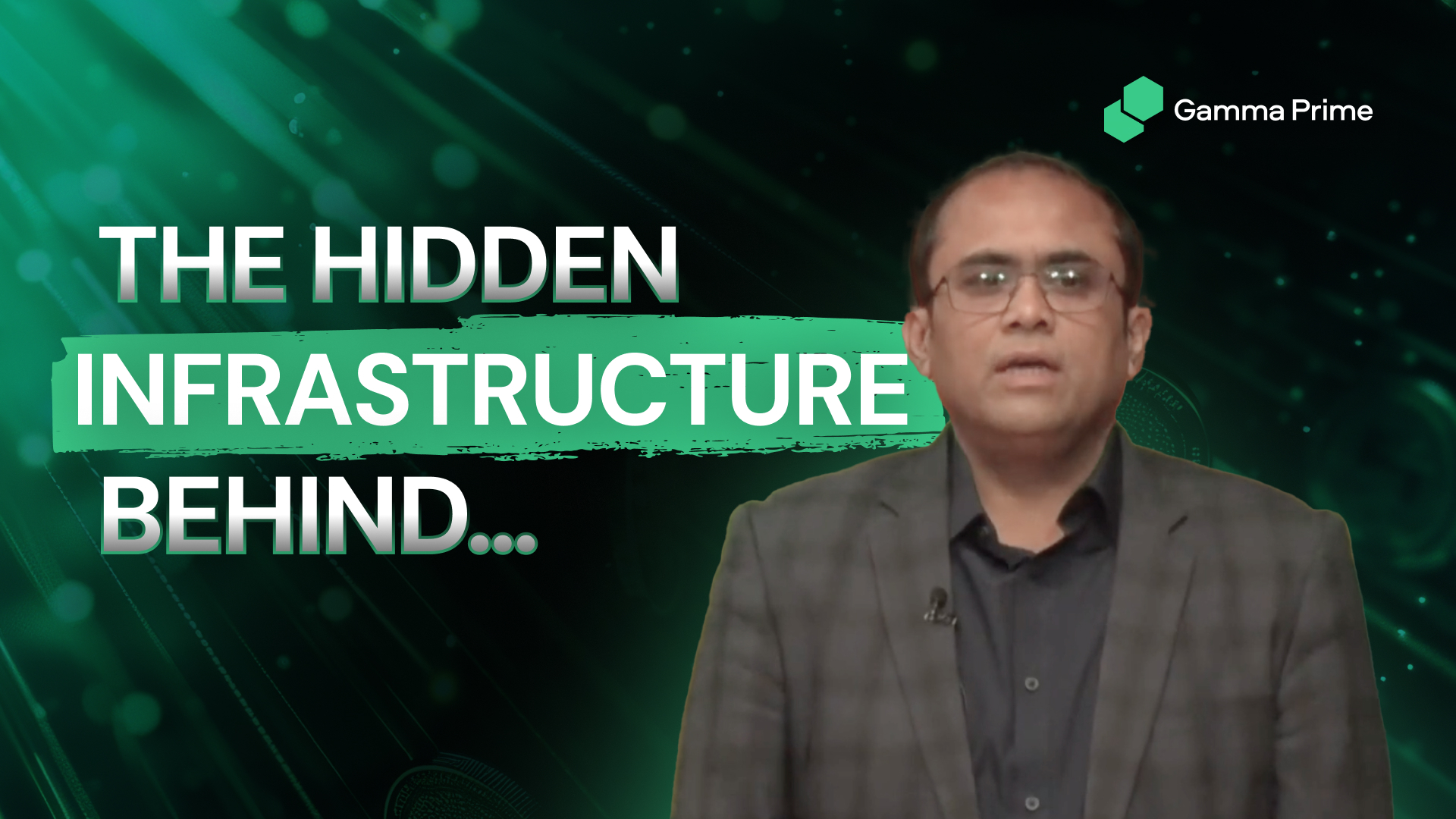
Keynote talk by Kallol Borah (Founder at Verified Network)
Evan Czu (Founder & CEO at Gamma Prime):
For our next guest, I want to introduce one of the sort of long-term entrepreneurs in this space. Calo here has been in entrepreneurship for, I think, four ventures now. He’s had multiple exits, and this is his latest venture.
He is building Verified Network, which is a platform entirely dedicated to the tokenization of real-world assets—exactly the sort of thing that we’re doing. Now he says that they are essentially like the plumbers of the system.
I think that’s a little bit unsexy. It’s actually the critical underlying infrastructure, and it really dovetails a lot with what we do at Gamma Prime, because Gamma Prime is taking things like hedge funds and bringing them on-chain. But our thing is distribution.
It’s essentially this. It’s the events and getting that out there. But to make it regulatory compliant in a way that funds would actually be willing to do is going to take something like Verified Network.
So please give it up for our next speaker, Calo Bora.
Kallol Borah (Founder at Verified Network):
Good morning, everyone. Good to see you all, and it’s great to be here at the Tokenized Capital Summit. My name is Calo Bora.
I run a group of companies called the Verified Network, and we effectively, as I was introduced, run the plumbing as far as tokenized real-world assets are concerned. And sorry—I’ll get to it. So yes, effectively what we do is we help asset managers issue tokenized products where the underlyings are real-world assets. We distribute tokenized RWAs, and then we help service them. So it’s a group of companies.
The Verified Network is not a legal entity, but it’s a group of companies that is spread across Switzerland, Luxembourg, the UK, and India, with different companies doing different things. The Luxembourg company is a securitization platform. We effectively securitize assets and issue products out of compartments or SPVs where the strategies are managed by asset managers.
Distribution is then handled out of the legal entity which is based in a free zone in India. It’s a company called VSV Securities, and it is capable of handling and onboarding investors globally. So that’s distribution, and we distribute through both traditional channels—wealth managers—but also digital platforms and DeFi protocols.
Once the product is distributed, of course investors need to be onboarded. We need to be regulation-compliant with KYC and AMLA norms everywhere. Some investors need advice. Custody needs to be arranged. Corporate actions need to be processed. So the entire lifecycle to manage the servicing of a tokenized product is something that is handled.
The UK entity is an FCA-licensed investment advisor and broker-dealer. So that is again a counterparty for trading underlying assets that underlie tokenized assets. So that is our business, and I’m here to actually talk more about and go in depth a little bit into the state of RWAs—where we go from here, what are the opportunities, what are the challenges, and really some of the processes around issuing, distribution, and servicing tokenized assets.
So this is, of course, a slide that I took from rwa.xyz. I think it’s a very well-compiled resource on different tokenized assets, and I think this is what we all know today. Most tokenized RWAs are now concentrated around treasury funds and money market funds. Also, a lot of tokenized private credit, thanks to the need for yield on different DeFi protocols such as Morpho and others.
So if tokenized treasuries were 10 billion, tokenized private credit is actually significantly higher than what I thought, at 19 billion. Then you have stocks, commodities, and bonds. So if you look at the assets under management, or the TVL, on treasuries and credit, it actually makes up most of what tokenized RWAs are doing today.
But the number of holders—token holders, the distribution—is actually far larger for tokenized stocks and commodities. Stocks, of course, I think we heard about Denari, and there is Xstocks. And then on commodities, we’ve got Tether Gold, Paxos, and all the gold-based products. So the number of holders in those is far larger.
Compared to tokenized markets, you’ve got the traditional markets on the right side where market caps are far larger, with stocks and bonds in excess of 100 trillion. Real estate, of course, is a very large space, and private equity and private credit are at least 10 trillion dollars. So RWAs have a long way to go beyond just tokenizing treasuries and private credit.
We, of course, help asset managers and strategy managers issue products, and I think it needs to be demystified a bit as to how a product is issued—what is an asset. So this is a very basic slide; I just thought it would make some sense.
First of all, assets could be securities, assets could be shares in a business, assets could be shares in a fund, or they could be loans that somebody writes out, or some real estate. So those are really underlying assets.
If you have securities like shares or funds or shares in a business, they typically go into a depository in any country. Every country has a depository, and the depository is nothing but a centralized database that has a record of all securities and issuers in that particular country.
And the funny thing is, when we talk about RWAs and tokenized stocks, we’re only talking about tokenizing listed stocks. We’re not talking about tokenizing private assets. A depository has both listed and unlisted securities in it.
We integrated through custodians in Switzerland, and we are integrating through custodians on multiple depositories. The chart below kind of shows that in Switzerland, for example, the depository has 750,000-plus securities, while listed on the Swiss Stock Exchange—including structured products and equities—it’s effectively 50,000 products. So you’ve got 10% listed and 90% unlisted.
In India, which is my home country, the number of companies in the depository is actually 45,000, but the number of listed companies on the exchanges is about three or four thousand. Which really means that tokenizing RWAs has to go beyond what is already listed.
The assets are really locked up with depositories. They are visible to depositories, but not visible to investors most of the time.
So you have business and fund shares going to a depository. You’ve got loans and real estate that go into SPVs. We obviously set up SPVs for our clients in Luxembourg, Jersey, and other friendly jurisdictions, which are ring-fenced from a risk point of view.
If it’s a security already in a depository, we can issue a depository receipt—a tokenized depository receipt. If it is an SPV, the SPV will issue a note or a certificate. A note is typically used for debt, effectively a liability, and a certificate can track the underlying asset.
The receipt tokens and the tokenized notes and certificates then go into a DLT—the ledger, the blockchain. It could be any blockchain. And then you have investors transacting using wallets.
This is the lifecycle which we manage as well, and this is quite important for managers or anyone trying to issue or manage tokenized securities.
Asset origination is very important. For example, in a loan portfolio, investors want to know default rates, manager credentials, and so on. Then comes product issuance, distribution, subscription allotments, and corporate actions—voting, dividends, stock splits, anything material.
On the asset side, listed assets could be stocks, bonds, and funds; unlisted could be private equity. On the product side, listed assets could be tokenized depository receipts or structured products. Unlisted assets could be equity-linked certificates, credit-linked notes, fund shares, etc.
Distribution happens through wealth managers across Asia, Singapore, India, the UAE, Switzerland, and the UK. Wealth managers care more about asset quality, managers, and credentials than whether something is tokenized.
We also work with DeFi protocols like Morpho, Euler, and Compound. Gamma Prime is also a distribution platform for tokenized RWAs. Trading venues are increasingly interesting—regulated exchanges in the EU, Hong Kong, Singapore, and Switzerland.
On servicing, we manage compliance, KYC, AMLA onboarding, trading, custody, accounting, tax, NAV calculation, and corporate actions. This is our bread-and-butter business.
There are also interesting opportunities: tokenized private company shares, pre-IPO unicorns, public stocks, bonds, commodities, art, and collectibles.
I think I’ve crossed my time, and I’m done with my presentation. You can get in touch with me on Telegram or email, or feel free to meet me.