Published on February 19, 2026
Watch the video of this panel on Gamma Prime’s YouTube channel:
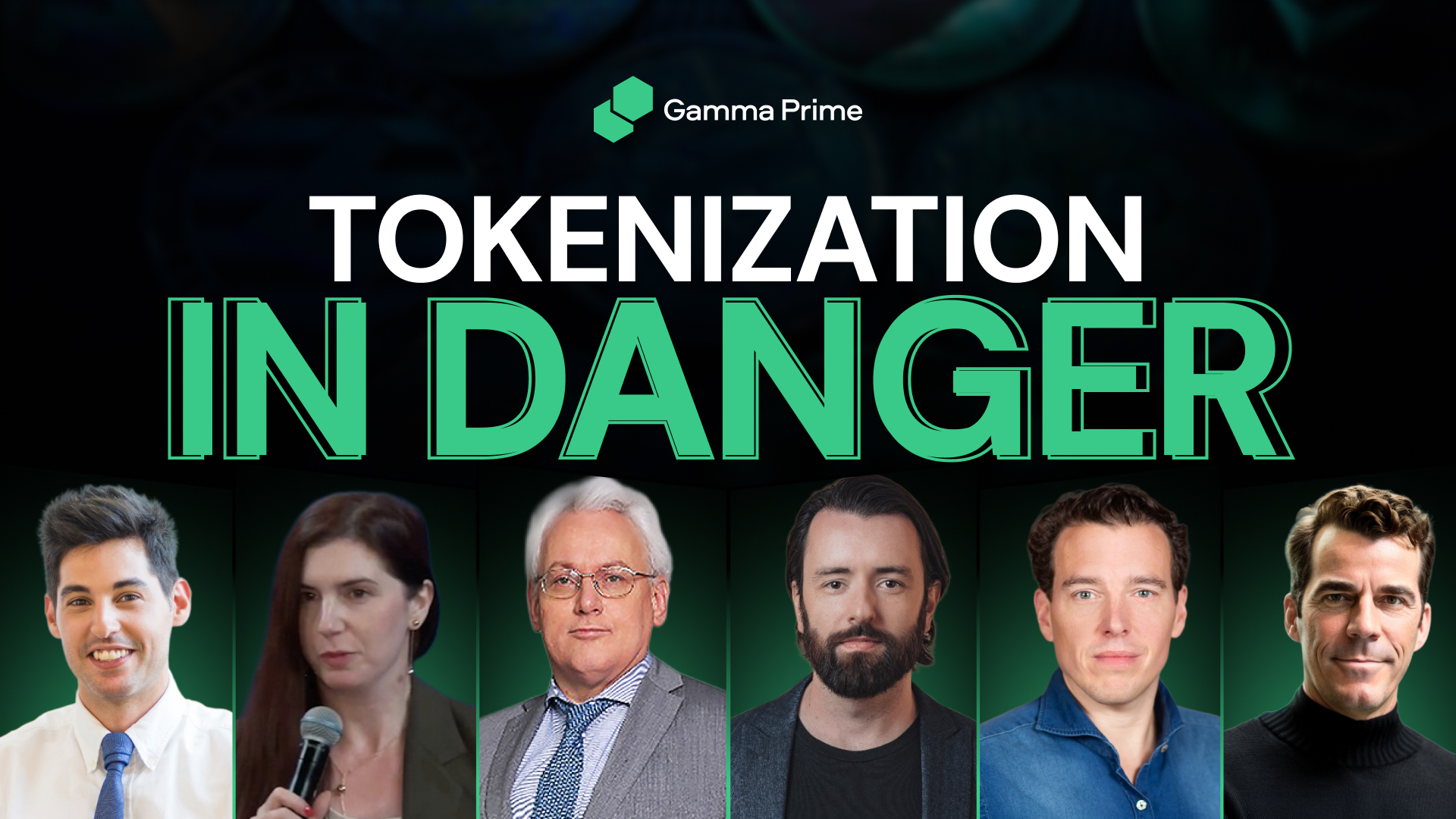
Panel talk with Lamon Rutten (CEO at eXchange1), Anna Wroblewska (Chief Business Officer at Dinari), Shauli Rejwan (MasterKey VC), Charles Edwards (Founder at Capriole Investments), Hein Tibosch (Head of Product & OTC, Digital Assets at Flow Traders), Henson Orser (CEO at Soter Insure) and Anna Tutova (Founder at AI Crypto Minds)
Anna Tutova (Founder at AI Crypto Minds):
Yeah, besides exchange-traded products, ETFs, we’re seeing a big acceleration in tokenization. There have been talks for many years, but now we’re finally seeing a lot of institutional investors and funds moving into blockchain-based tokenization. We’ve also seen Nasdaq file with the SEC to allow the trading of tokenized products.
And I think once that’s approved, it will be massive for adoption. Currently, we’re seeing the biggest adoption on the private credit side, as well as in tokenized U.S. Treasuries. If you look at reports from firms like State Street, they predict that tokenization will be one of the main investment themes over the next three to nine years.
They project that institutional investment allocations could reach 10–24% into tokenized products. However, there are still significant risks for institutional investors when investing in crypto and tokenized products, as the technology remains relatively unexplored and there are considerable security risks. So my next question is to Hanson, who runs the insurance company.
Over the years, we’ve seen a ton of hacks and scams within the crypto space that understandably make institutions uneasy. So SOTY is offering insurance to advance institutional adoption. Insurance tends to work well in large, well-established fields like life insurance, where historical data is reliable.
But in an emerging field like crypto, how do you assess the risk of theft, loss of crypto, and technology risk? And how do you properly serve those clients? Can you tell us more?
Henson Orser (CEO at Soter Insure):
Great, thank you, Anna. Just to give some background on SOTY: we were running Komainu, a large institutional-grade custodian with billions of dollars’ worth of Bitcoin under custody.
We were licensed in Jersey and working on obtaining a license in Dubai. Insurance was very important to us, both on the D&O side and on the crime and specie insurance side, especially with financial institutions holding assets with us as a qualified custodian.
The traditional London-based insurers have been slow to offer large insurance towers. They’ve been very specific about coverage, and the capacity, when available, has been expensive. When running VARA, we required all our licensees to obtain insurance, and once again it was difficult to secure and often prohibitively expensive.
Protecting individuals and financial institutions who hold assets with qualified custodians or wallet providers is a key part of enabling institutional adoption. Additionally, London-based providers typically offer coverage denominated only in fiat. If you have $100 million of insurance and Bitcoin moves from $100 million to $1 billion or down to $10 million, you’re either overinsured or underinsured at any given time.
Our novel approach is to offer insurance denominated not only in fiat but also in Bitcoin and Ethereum. We also offer a slashing product denominated in Ethereum for professional proof-of-stake providers.
As a regulated entity, we must hold regulatory capital. We are BMA licensed and must hold capital to offer insurance denominated in Bitcoin, receive premiums in Bitcoin, and pay claims in Bitcoin. That means we hold Bitcoin as regulatory capital.
On the demand side, less than 1% of all Bitcoin held in custody is insured, representing a very large addressable market. If premiums exceed claims, Bitcoin capital providers can earn attractive risk-adjusted, reinsurance-style returns. This creates a Bitcoin yield component to our business if we underwrite effectively.
We’re also in the process of tokenizing that Bitcoin capital so it can be deployed into the marketplace and eventually democratized, allowing small, medium, and large participants to access Bitcoin-denominated insurance yield.