

Published on March 27, 2026
The Investor Who Got Left Behind
Michael is a successful business owner with $5 million to invest. His brokerage account is diversified across stocks and bonds – the traditional portfolio his financial advisor recommended decades ago. His returns hover around 7% annually. He reads articles about venture capitalists earning 25% returns. He sees news about private equity firms generating life-changing wealth. He wonders: why is he locked out? Why does wealth generation seem to happen in private markets while ordinary investors are stuck in public stocks? The answer lies in understanding private market investing, a category of opportunities that has historically been invisible to individual investors. That era is ending.
For decades, private markets were the exclusive domain of wealthy families, institutions, and sophisticates. If you weren’t managing a multi-billion-dollar family office or running a university endowment, you didn’t have access. Your wealth was trapped in public stocks earning adequate but uninspiring returns while insiders participated in extraordinary opportunities. But the landscape is changing rapidly. Technology, regulatory evolution, and new platforms are democratizing access to private markets. Understanding what private markets are and how to participate is now essential for any serious investor. The return differential compounds dramatically – a 5% difference in annual returns over 30 years creates exponential wealth gaps. That’s what makes this understanding not just academically interesting but genuinely life-changing for your financial future.
This guide explains everything you need to know about private market investing. We’ll answer fundamental questions: What are private markets, really? How does private investing actually work? What makes it fundamentally different from stock market investing? What can you realistically expect? What risks should you understand? And most importantly, how can you gain access to alternative investment marketplaces?
By the end, you’ll understand why sophisticated investors and family offices are allocating 20-40% of portfolios to private assets – and how you can do the same. The gap between insider wealth creation and ordinary investor returns is not random. It’s structural. It’s systematic. And it’s increasingly addressable. Understanding private markets and how to access them isn’t optional anymore for serious investors. It’s foundational to building wealth in the 21st century.
What Are Private Markets? Understanding an Entirely Different Asset Class
Start with the basic question: what are private markets? In simple terms, private markets are investments in assets that are not traded on public exchanges like the New York Stock Exchange or NASDAQ. When you buy a stock, you’re trading it on a public market where millions of shares change hands daily at transparent prices. Private markets are the opposite. They involve investments in companies, real estate, infrastructure, or credit instruments that remain privately held. These assets are less liquid, less transparent, and less accessible – but they offer something public markets often can’t: exceptional returns and opportunities unavailable to ordinary investors.
Private markets encompass a diverse ecosystem of private market investments. Private equity funds invest in private companies, often buying them entirely and working to increase value over 5-10 years before selling. Private credit funds provide loans to mid-market companies that can’t or won’t access traditional bank financing – a category growing explosively as traditional banks retreat. Real estate funds invest in commercial or residential properties, often with value-add strategies. Infrastructure funds provide capital for toll roads, airports, utilities, and essential assets generating stable long-term cash flows. Venture capital funds invest in early-stage companies before they go public, targeting exponential growth. Secondary funds buy existing stakes in other private funds, providing liquidity. Hedge funds, in many cases, operate in private markets. Each category operates differently, but all share a common characteristic: you can’t walk into your brokerage and buy them like you would Apple stock.
The critical distinction between private markets and public markets is structural and profound. Public markets prioritize liquidity and transparency. You can sell your shares immediately at the current market price. Everyone has access to the same information about valuation. Regulation ensures disclosure and investor protection. Trading volumes are enormous, creating efficient pricing. Private markets operate entirely differently. Assets are illiquid – you may not be able to sell for years. Valuation happens infrequently, sometimes only annually. Information flows are controlled by managers. Access is restricted to accredited or institutional investors. These structural differences aren’t flaws – they’re features that enable the operational improvements and long-term strategies that drive superior returns. These characteristics make private market funds fundamentally different vehicles from mutual funds or ETFs.
Understanding private market funds is essential because they’re the primary vehicle for individual investors to participate in private markets. Rather than trying to invest directly in private companies – which would require enormous capital and expertise – most investors access private markets through pooled funds. You contribute capital alongside other investors. Professional managers deploy that capital into private assets. Your returns flow from their investment success. This structure democratizes access to strategies and opportunities that were previously available only to billionaires and institutions. A $50,000 investment through a fund gives you exposure to opportunities previously requiring $1 million minimum commitments.
How Does Private Investing Work? The Journey From Commitment to Return
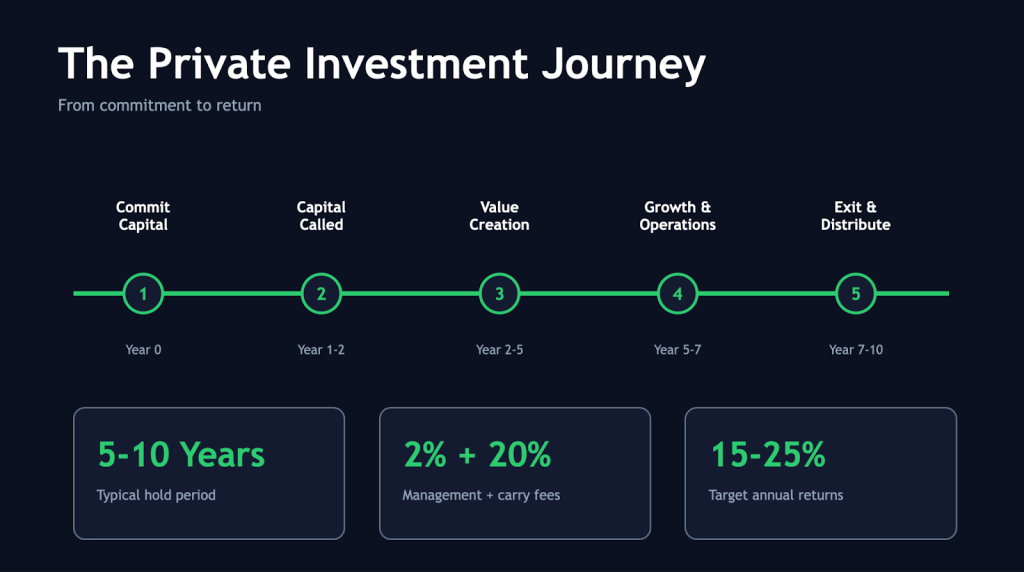
Understanding how private investing works requires grasping a multi-year process that’s radically different from stock investing. When you buy a stock, execution is instantaneous. You click ‘buy,’ and you own it within seconds. The journey ends. With private markets, the journey is just beginning. This multi-year process is where the real value gets created.
The process starts with a capital commitment. You decide to invest $100,000 in a private equity fund targeting mid-market business acquisitions. You don’t send $100,000 immediately. Instead, you commit to providing capital when the fund calls for it. This commitment structure allows managers to show limited partners they’ve raised capital while giving them time to find the right deals. Over the next 18-36 months, the fund spends months or years evaluating potential acquisitions. When they find a target, they negotiate, perform due diligence, and complete the acquisition. Your capital is called as needed. The fund manager then spends 2-3 years deploying capital, acquiring companies, and implementing operational improvements. You’re not involved in daily decisions – that’s the manager’s job. But your money is working. The companies are being improved, earnings are growing, and value is being created. This is why investing in private markets requires a completely different mindset from buying stocks.
After 5-7 years, the fund manager engineers exit events. Maybe they sell a portfolio company to a larger buyer. Maybe they take a company public through an IPO. Maybe they sell to another private equity firm who sees additional upside. The important point: your investment generates returns. These returns flow back to you as distributions. This entire cycle – commitment through exit – takes years. This is why private market investments require patience and capital you genuinely don’t need for 5-10 years. It’s fundamentally different from public market investing where you can sell tomorrow. It’s also why returns are often superior – the illiquidity premium compensates you for capital you can’t touch.
The structure of private markets funds typically follows a predictable pattern. Managers target a specific timeframe – usually 5-10 years – called the fund’s vintage year. They charge management fees – typically 2% annually – regardless of performance. This covers operations, deal teams, and infrastructure. They take a carried interest – typically 20% of profits – aligned with investor returns. This fee structure incentivizes managers to create value while ensuring they’re compensated for ongoing work. It’s different from mutual funds that charge 0.5-1% annually and have no performance incentive. These structural differences reflect the reality that private market success depends entirely on manager skill and commitment.
What Makes Private Market Investing Unique: Key Differentiators
Private market investing has characteristics that fundamentally separate it from public market investing. First, the time horizon is measured in years, not days. You commit capital for 5-10 years. You can’t panic sell if markets drop. You can’t adjust if an opportunity seems better elsewhere. You’re betting on the manager’s ability to execute over a long period in uncertain circumstances. This requires faith in two things: the strategy and the manager. A stock investor can reallocate when market conditions shift. A private investor is committed regardless.
This certainty of capital allows managers to make decisions public companies can never make – long-term strategic bets that might sacrifice next quarter’s earnings for multi-year value creation. That trade-off between flexibility and opportunity is core to understanding private markets. Second, liquidity is non-existent. Unlike stocks you can sell in seconds, private market stakes are illiquid. You’re locked in until the fund distributes proceeds at exits. This illiquidity premium exists for a reason – managers need certainty about capital to make long-term investments that might take years to mature. Certainty transforms everything. Managers can invest in companies, hold them while they mature, and avoid pressure to sell prematurely just because markets become turbulent.
Third, valuation is opaque and infrequent. Your public stock account updates second-by-second showing current market value. Your private fund valuation may update annually using methods you don’t fully understand – internal rate of return calculations, comparable valuations, discounted cash flow models. This opacity creates both risk and opportunity. Risk because you’re less informed. Opportunity because less efficient pricing sometimes creates better values for skilled managers. Consider this: when a software company’s stock trades publicly, thousands of analysts constantly evaluate its valuation. Information is ruthlessly priced in. But a private software company operating without public scrutiny might have hidden value. Managers who understand the business better than the market can exploit this information advantage. Fourth, managers are actively involved in driving value.
Public market fund managers rarely meet the CEOs of companies they own. Private market managers are intimately involved, sometimes joining boards or making operational decisions. This active management is why they charge higher fees and why manager selection matters profoundly. A manager who can identify problems early and implement solutions drives exceptional returns. Fifth, downside protection exists because private assets aren’t marked-to-market daily. In 2008, stock investors watched portfolios decline 40% in real-time, triggering panic selling. Private investors saw annual valuations decline but with flexibility to hold until recovery. That flexibility to weather storms without forced liquidation is a genuine advantage during crises.
Benefits of Private Market Investing: Why Sophisticated Investors Allocate Heavily
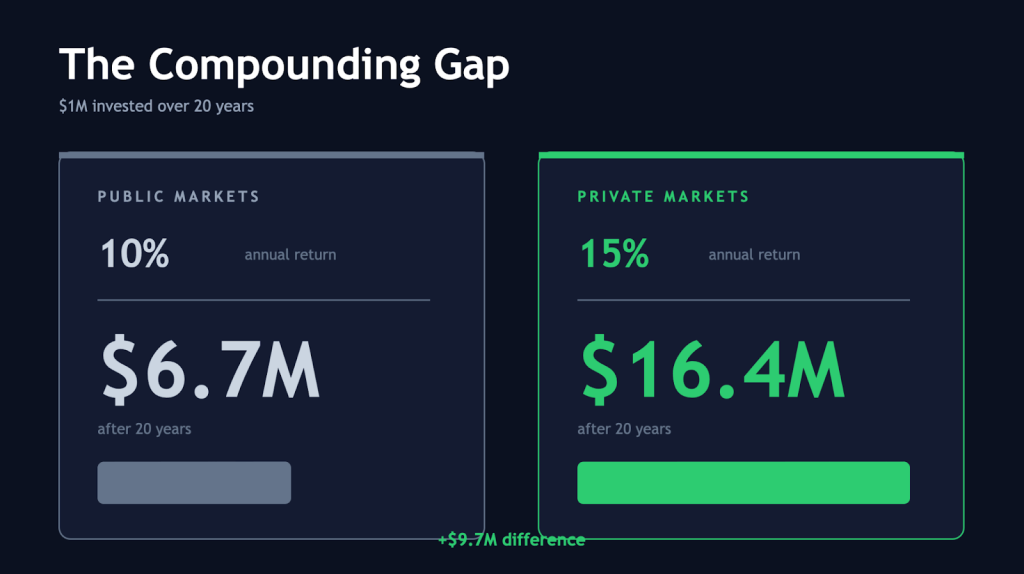
Family offices and endowments allocate 25-40% of portfolios to private markets for compelling reasons. First, returns. Private market managers targeting mid-market businesses often generate 15-25% annual returns compared to public market returns of 10%. This may seem like a small difference, but over 20 years, it compounds into profound wealth differences. A $1 million investment growing at 15% annually becomes $16.4 million. Growing at 10% becomes $6.7 million. The difference is $9.7 million. That’s the power of private market returns.
Second, diversification. Private markets have lower correlation with public stocks. When recessions hit stock markets, private portfolio companies don’t instantly lose value the way public stocks do. This non-correlation makes private markets valuable portfolio diversifiers that actually deliver portfolio stability when you need it most.
Third, inflation protection. Real assets like infrastructure or real estate tend to hold value during inflationary periods. The toll road you invested in generates higher revenues as traffic increases and inflation rises. The real estate property you invested in generates higher rents. Publicly traded companies struggle with inflation pressures on costs and pricing power. Private assets provide natural hedges.
Fourth, access to exceptional companies. The best investment opportunities – transformative ventures or high-growth companies – often occur in private markets years before IPO. By participating in private market funds, you gain exposure to these opportunities.
Fifth, downside protection. Private market managers have flexibility to weather downturns. They’re not marked-to-market daily. They can hold positions longer for better exits. This flexibility often results in better downside protection than public markets where selling pressure can create cascading losses.
Sixth, strategic positioning. Private assets often provide operational insights. Investors in infrastructure funds understand how toll roads function. Investors in real estate funds understand commercial property dynamics. These insights have value beyond financial returns.
Risks and Tradeoffs: Understanding What You’re Committing To
Private market investing involves meaningful risks absent from public market investing. First, illiquidity is the elephant in the room. You’re locking capital for 5-10 years. If circumstances change and you need cash earlier, you can’t easily access it. You could sell at a discount through secondary markets, but that involves costs and your return suffers. This illiquidity creates real risk if you miscalculate your capital needs.
Second, valuation uncertainty is substantial. How much is your stake really worth? You’re relying on manager valuations using methods you may not fully understand. This information asymmetry creates risk. Third, manager selection risk is paramount. Success depends almost entirely on manager skill and judgment. Bad managers destroy capital. Selecting the right managers requires deep due diligence.
Fourth, longer time horizons mean longer exposure to market risks. If you invest in venture capital targeting 10-year exits, you’re exposed to 10 years of market uncertainty, management changes, competitive dynamics, and black swan events. Consider this scenario: You commit to a venture capital fund in 2020. By 2023, the startup environment collapses, interest rates spike, and capital-intensive companies struggle. Your fund’s portfolio companies face headwinds but you can’t exit. You’re locked in. Fifth, higher fees compound. You’re paying 2% annually plus 20% of profits. Over 10 years, these fees significantly reduce gross returns.
If a fund generates 18% gross returns and deducts 2% fees plus 20% of profits (roughly 3.6% on average), you’re left with 12.4% net returns instead of 18%. Sixth, complexity is substantial. Understanding how private investing works requires financial literacy. You’re evaluating fund structures, manager track records, portfolio company fundamentals, and exit probabilities. This complexity means you can’t blindly delegate – you need to understand what you’re committing to. Seventh, regulatory risks exist. Private markets face evolving regulations.
Changes could affect returns or accessibility. Eighth, manager fraud, though rare, has occurred. Ensure managers have audited financials and proper governance. These risks are real and demand serious consideration. Private market investing isn’t appropriate for investors needing liquidity, investors uncomfortable with complexity, or investors with low risk tolerance.
Private Market Examples: How Real Investors Participate
Understanding private market examples helps clarify how this abstract concept works in reality. Consider a family office with $200 million in assets. They allocate $50 million to a private equity fund targeting mid-market acquisitions in software and services. The fund takes that capital plus capital from other investors and buys a software company for $300 million. The company has strong products but outdated operations and poor management.
Over the next 5 years, the fund invests in operational improvements, replaces the CEO, invests in product development, and pursues strategic acquisitions. The company’s earnings increased 30%. The fund sells the company to a larger enterprise software company for $450 million. The original $50 million investment has grown to $75 million. The family office receives their share of proceeds. This is a private market example in action showing how value is created through operational improvements, not just market multiple expansion.
Another example involves venture capital. An investor commits $25,000 to a venture fund investing in early-stage software companies. The fund invests in 20 companies over three years. Most fail. But three succeed and get acquired or go public. The investor’s portion of the winning investments returns $75,000. This private market example shows how venture capital works – you’re betting on variance, knowing most will fail but a few will succeed spectacularly and drive overall returns.
Private Markets vs Private Equity: Understanding the Difference
Many people use private markets vs private equity interchangeably, but they’re not the same. Private equity is a subset of private markets. Think of it as concentric circles. Private markets are the large outer circle encompassing everything not traded on public exchanges. Private equity is a smaller inner circle within private markets. Private equity specifically involves buying companies, improving operations, and selling them 5-10 years later. Private equity is a strategy within private markets, not the entirety of it. This distinction is crucial.
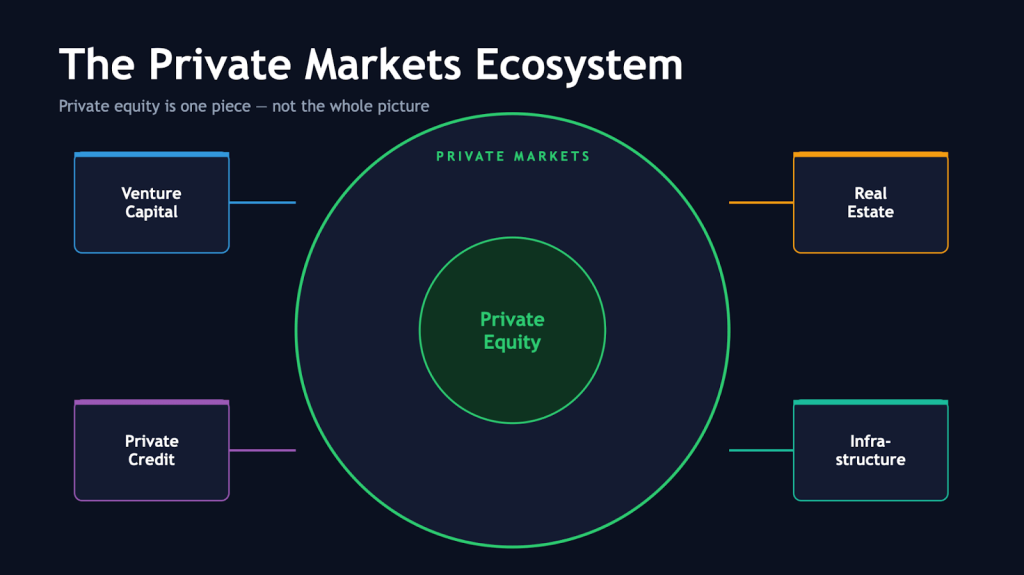
The distinction matters because it affects strategy, returns, and risk. Private equity targets operational improvements – management changes, cost reductions, strategic acquisitions. Private credit targets financial returns from lending. Infrastructure targets stable long-term cash flows from essential assets. Venture capital targets exponential growth from early-stage companies. Real estate targets cash flow plus appreciation.
Understanding this distinction helps you evaluate what investing in private assets means. When you hear private equity is generating exceptional returns, recognize that private market investing encompasses strategies with different risk-return profiles.
How Gamma Prime Transforms Private Market Access
Historically, private market investing was available only to institutional investors and ultra-wealthy individuals. Information was inaccessible to ordinary investors. Opportunities were opaque. Minimums were prohibitive. Manager selection was based on personal relationships and golf course connections. This exclusivity was intentional – managers wanted to avoid dealing with unsophisticated investors asking constant questions. But this exclusivity meant ordinary investors were locked out of extraordinary opportunities, forced to accept public market returns while insiders generated wealth in private markets.
Gamma Prime changes this equation fundamentally. We’ve built technology and processes to democratize access to private market funds for individual investors. We aggregate demand from multiple investors to meet fund minimums. We provide transparent information about fund strategies, manager track records, risk profiles, and historical performance. We handle administrative complexity – paperwork, capital calls, distributions, tax reporting. We provide secondary market access, allowing investors to maintain portfolio flexibility even with long-term commitments. We help investors understand how private investing works through education and ongoing support.
If you’re interested in investing in private assets but intimidated by complexity and access barriers, Gamma Prime is your solution. We connect serious investors with world-class private market investments. We guide you toward strategies aligned with your goals and risk tolerance. We provide ongoing support and transparency. Whether you want exposure to private equity, venture capital, real estate, infrastructure, or private credit, Gamma Prime enables access previously available only to the ultra-wealthy.
Create your Gamma Prime account today and join thousands of accredited investors gaining access to the private market returns that have historically been exclusive. Your portfolio’s future depends on understanding where wealth is actually being created. That creation is happening in private markets. It’s time to participate.