Watch the video of this panel on Gamma Prime’s YouTube channel:
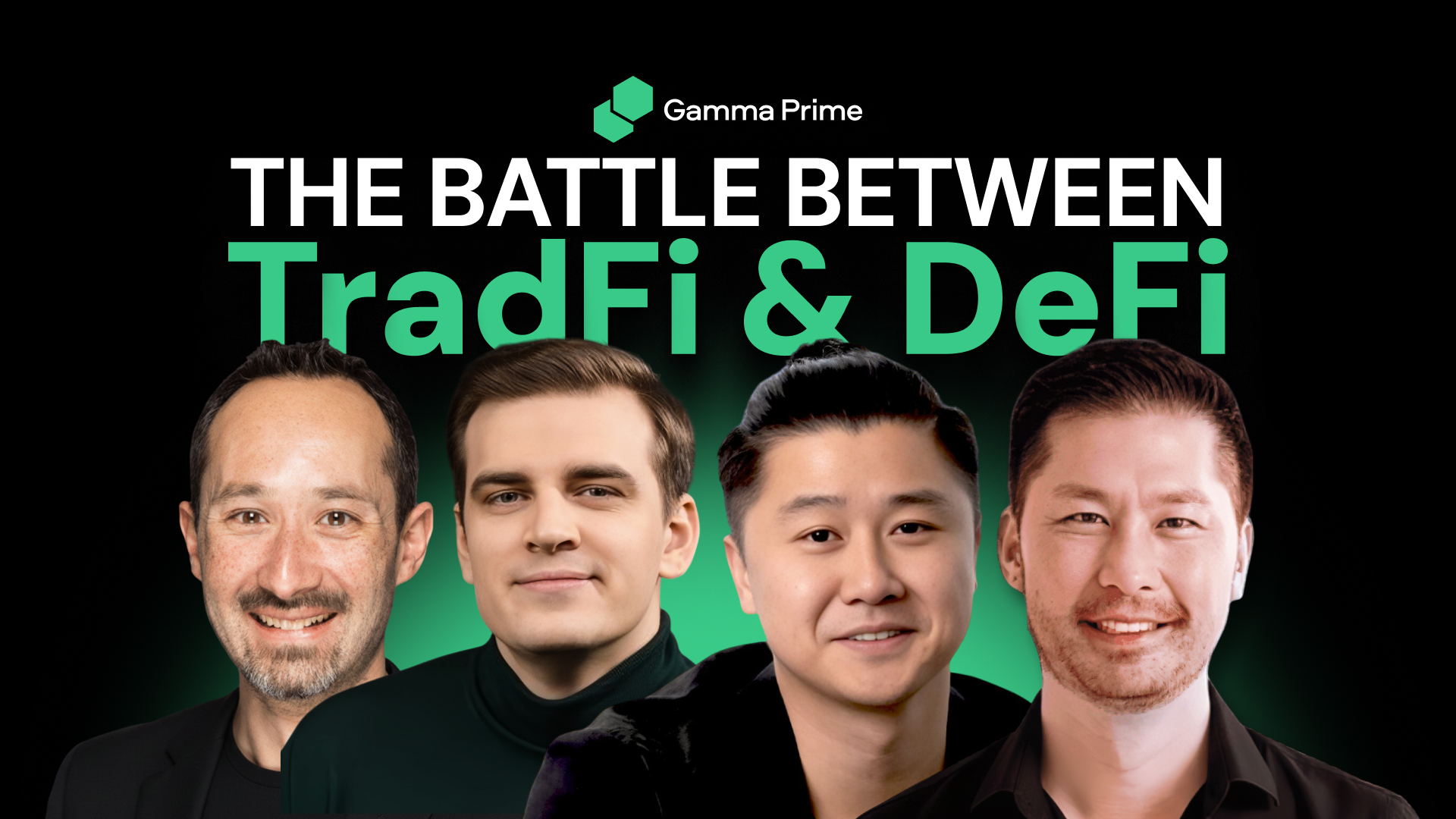
Panel talk by Sebastien Borget (CEO & Co-Founder at The Sandbox), Alex Esin (CEO at P2P.org), Kenneth (Project Lead at Moca Network and Animoca Brands), Evan Szu (CEO at Gamma Prime) and Eric Benz (Founding Partner & Managing Director at MYNT)
Eric Benz (Founding Partner & Managing Director at MYNT):
Now, just getting back to the topic, you know, I wanted to kind of bring up, what’s the biggest friction point between TradFi and DeFi? I mean, this is a very basic question, but also, I think, a very important answer. Do you want to start? Go ahead. You have the mic.
Sebastien Borget (CEO & Co-Founder at The Sandbox):
Well, I cannot maybe speak too generally about the topic, but I want to apply a little bit of knowledge and experience I’ve acquired in video games. Typically, gamers, I believe, have been intuitively, or maybe without knowing, some of the best people in the world that tend to make arbitrage and taking decisions to optimize always for the best outcome. Whenever we decide to make a purchase in a game, we buy currency, or we choose to spend the hard-earned experience point to upgrade the different characters, avatar, etc., we will always optimize for the best outcome that will deliver for us, like best return afterwards, to collect more resources, and so on.And so, I do believe that gaming has been one of the best ways, not only to bring adoption to our blockchain, but to bring more understanding about financial literacy into the world of blockchain, and kind of bridge a lot of users who are not DJs, who are not traders, to actually learn and become actual traders, but using all the benefits that DeFi has to offer through decentralized exchange and the quick access to our crypto. Yet, a whole bunch of the media and the industry still think the UX is difficult, the onboarding is difficult in general, because they want to bring even more users. But I do think, obviously, in the disguise of a very simple entertainment product, we’ve already been able to push more people to actually become traders, without necessarily knowing about it.And when you see a lot of the games, from the early X-Infinity, and what they push with Play-to-Earth, or now we’re seeing new games like the Map of Stories universe, or Craft World, etc., or NFL Revolve, those games are actually making people trade and trade more and more game items, collectibles, or tokens, towards generating more outcome and more revenue for the players. The game field is much bigger, thanks to the use of the technology here and the use of DeFi. So, that’s my take on the topic.
Alex Esin (CEO at P2P.org):
I think the short answer, first, is regulatory. We still have a lack of clear understanding of the rules for some specific regions. In some cases, it’s just moving forward in the dark room, and then we believe, before us, it’s not the wall, it’s something that is free space.The second, I think, is we speak a lot about KYB, KYC, but right now, the issue about the KYB, know your protocol. Right now, we have a lack of common, banal standard system to measure some risk of protocols. And every time it’s a new game, and right now, lag between both is regulatory, and assess of different protocols, as a result, there’s no friction between TradFi and DeFi, from my point of view.
Kenneth (Project Lead at Moca Network and Animoca Brands):
Yeah, I think there are four main angles. One is the user experience, more on the key management side of things. Second is the liquidity, in terms of, like, on the DeFi side and CeFi side.If it’s TradFi, how do you bridge that liquidity? We see the likes of Coinbase, and already tapping into that, basically having centralized exchange liquidity flowing into Aerodrome DEX. And third is regulation, which digital identity plays a big role there. That’s what we’re building.How do you balance decentralization, privacy reserve, identity and data, and the compliance and regulator requirements? I think fourth is the programmability. In TradFi, is having programmability would take a lot of time if there’s prone to error, just because, like, there are not codes. And once you tokenize more assets and securities, for instance, and there are many ways to play around with DeFi, such as, like, co-authorization, like, under-secured loan.There are many things that you can do with data and programmability between TradFi and DeFi.
Alex Esin:
Just to have a discussion, guys, you mentioned, I know, user experience is one of the friction between TradFi and DeFi. But what does it mean for you? Because right now, I mean, because I work a lot with big institutional players, TradFi players, and every time I have heard about, like, I know user experience is a problem, but what specific problem could you maybe add more colors?
Eric Benz:
And where are we actually seeing the meaningful collaboration, you know?
Kenneth:
I mean, the fact that when you’re on the DEX, the user experience is, I want to swap this token to another token, is not an intuitive experience.Like, in normal user behavior, it’s just, I want to buy this token. Just something as simple as that, right? And then, like, there are multiple signing processes, approving token on-chain transaction, and then you can trade. Obviously, some are, like, optimizing user experience by having, like, bundle or session key, stuff like that, to actually abstract that away.And HyperLiquid is doing an amazing job on basically, like, a hybrid mode of, like, a centralized trader user experience, but having, like, an on-chain smart contract for trading with more relatively centralized market-making liquidity in some ways. So, I think there’s a collection of multiple things there on user experience.
Alex Esin:
Yeah, but what do you think is the problem for TradFi? Because if you speak for TradFi, they mostly look like, as I know, custodians for exchanges, when the people just interact with their interface, they don’t care about the behind process, the ground process.For them, the same, like, as in the bank, you can just click, and you don’t care, take the on-chain, off-chain, et cetera. Why do you think it’s a big problem?
Evan Szu (CEO at Gamma Prime):
Maybe I could take a slide at that, because that was actually my response, too. Okay.The user experience needs to add something, right? It can’t just be, oh, we’re tokenizing for the sake of tokenizing. But why does somebody care about that? So, I’ll give you an example. There’s a lot of people tokenizing treasuries, but there’s already a tokenized-like experience if you want to go buy treasuries.You don’t need to go and bid with the U.S. government. You just go and log on to E-Trade, and you can buy fractions, right? Now, you don’t get self-custody, but you get a lot of the effects of tokenization. You get margin across all these different products.So, in my mind, it’s about what’s the motivation for bringing these worlds together? How is somebody going to go, I want that version and not this? So, one example might be more like Dutch real estate, for instance, right? That’s something that’s like, but there are ETFs now, right? We focused on hedge funds, of course. We think that’s a good area. But I think that’s a key question, which is why? Why would this matter to anybody? Are you solving a real problem?
Eric Benz:
Totally.
Sebastien Borget:
I’d like to jump on the topic as well. I do think people are criticizing the onboarding, the user interface, but I do think if you’re legitimately trying to onboard a traditional trade file platform, a broker, to buy some stocks, some commodities, et cetera, it’s so complex. First, you have to find a bank or financial partner to go through a lot of paperwork.It takes usually weeks, and then nothing is perfectly correct, and you need to upfront cash. It literally takes a few minutes to a few hours, at best, to onboard to one of those platforms. And no matter what kind of asset you actually want to trade, whether they are Pokemon cards or sneakers, a fraction of them, or art or game items on marketplaces, there’s already a much simpler onboarding.However, the tradeoff between this onboarding speed and behind the security of what actually you are trading and how secure and legitimate or backed by a real-world asset or real value are those assets. And so the risk also comes from the fact that it’s very unregulated. Anyone can trade whatever without a strong fundamental behind.
Eric Benz:
Interesting. Very cool.